For my BSc (Hons) Network Engineering dissertation, I tested the three best-known dynamic routing protocols, RIPv2, OSPF and EIGRP, side by side on the same network to answer one simple question: which one converges fastest? Here's what I found, explained in plain English, plus a free one-page cheat sheet to keep by your keyboard.
Watch the video version (1 min 34 s)
I've put my lab results into a short video on my FrƎƎjack Tech YouTube channel. Short on time? Watch my 60-second Short on YouTube.
What is dynamic routing?
A router's job is to pass your data along to the next router until it reaches its destination. To do that, it keeps a routing table, which is basically a list of "to reach this network, go that way".
You can fill that table in two ways:
- Static routing: you type every route in by hand. It's simple and puts no extra load on the router, but on anything bigger than a small network, keeping it up to date becomes a full-time job.
- Dynamic routing: the routers talk to each other using a routing protocol, share what they know, and update their tables automatically. If a link fails, they work out a new path on their own.
The time it takes for every router to agree on the new picture of the network is called convergence. Until a network has converged, some traffic can go the wrong way or get dropped, so faster convergence is better.
How the three protocols work
RIPv2 (Bellman-Ford). RIP is a distance vector protocol. Each router tells its neighbours "here's everything I know and how many hops away it is", then those neighbours pass it on. The best path is simply the one with the fewest hops, and anything over 15 hops counts as unreachable. RIPv2 sends its whole table every 30 seconds, whether anything has changed or not.
OSPF (Dijkstra). OSPF is a link-state protocol. Rather than passing on gossip, every router builds its own full map of the network, then runs Dijkstra's shortest path first algorithm to work out the best route to everywhere. Its metric is "cost", which is based on link bandwidth. It only sends updates when something changes, and large networks can be split into areas.
EIGRP (DUAL). EIGRP was developed by Cisco and is often called a hybrid (or advanced distance vector) protocol. It uses the Diffusing Update Algorithm, DUAL, which keeps a loop-free backup route, called a feasible successor, ready in advance. If the main route fails and a backup exists, EIGRP can switch to it almost instantly instead of recalculating from scratch. Its metric uses bandwidth and delay.
How I tested them
My original plan was to run the whole thing on real Cisco kit in the college lab. After a difficult few months at home, I'd been back at uni for one day when lockdown closed the lab, so I had to rebuild the entire experiment in software. It was frustrating at the time, but it proves a useful point: you don't need a rack of expensive routers to learn this stuff properly.
I started with a pilot study in Cisco Packet Tracer on a small three-router topology. Its simulation mode let me slow time down and watch the routing packets move around the network, which is brilliant for learning. However, it can't work with third-party monitoring tools, so it gave me very little hard data.
For the main experiment, I moved to GNS3 and captured the traffic with Wireshark. I built the same topology three times, once for each protocol: five Cisco routers joined by serial links, with a loop in the middle (R2, R3 and R4) so there was always an alternative path, and a PC at each end. Each build used identical addressing, so the only difference was the routing protocol.
What I found
EIGRP was the clear winner. Here are the average convergence figures from my results chart, measured at two-minute points across a ten-minute run:
| Time | RIPv2 | OSPF | EIGRP |
|---|---|---|---|
| 0 min | 15.6 | 39.3 | 0.02 |
| 2 min | 22 | 26 | 0.018 |
| 4 min | 29 | 18.2 | 0.015 |
| 6 min | 34.7 | 17 | 0.014 |
| 8 min | 30 | 16.8 | 0.013 |
| 10 min | 27.7 | 16.4 | 0.012 |
Lower is better. Figures are the average convergence duration read from my results chart.
- EIGRP stayed between 0.012 and 0.02 throughout, which is hundreds of times lower than the other two.
- OSPF was the slowest at the start (39.3), because every router has to discover its neighbours and build a full map first. Once it had settled, it steadied out at around 16 to 18.
- RIPv2 got worse as the run went on, peaking at 34.7. On top of that, its full-table updates every 30 seconds wasted bandwidth, around 0.11 Mbps each time in my capture.
- OSPF also created a big burst of traffic in its first couple of minutes while the routers were getting to know each other, then went quiet.
Side-by-side comparison
| RIPv2 | OSPF | EIGRP | |
|---|---|---|---|
| Type | Distance vector | Link state | Hybrid (advanced DV) |
| Algorithm | Bellman-Ford | Dijkstra (SPF) | DUAL |
| Metric | Hop count | Cost (bandwidth) | Bandwidth + delay |
| Admin distance | 120 | 110 | 90 internal / 170 external |
| Hop limit | 15 | No hop limit | 100 by default (max 255) |
| Updates | Full table every 30 s | Only on changes | Only on changes |
| Convergence in my lab | Slow | Slow start, then steady | Fastest by far |
| Best for | Small, simple networks | Large or mixed-vendor networks | Cisco networks needing fast failover |
Which one should you use?
- RIPv2: fine for a small lab or a simple network with a handful of routers, and the easiest to learn first.
- OSPF: the go-to open standard. It scales well with areas and runs on almost any vendor's kit, so it's the safe all-rounder.
- EIGRP: the fastest in my tests and easy to set up, so it's a great choice if your network is all Cisco.
A few honest caveats
- EIGRP was Cisco-only for years. Cisco published it as an informational RFC (RFC 7868) in 2016, but in practice you'll still mostly find it on Cisco gear.
- My results come from one five-router topology in a simulator, with default settings. A big real-world network on physical hardware could behave differently, and doing exactly that is the next step I'd like to take.
Grab the free cheat sheet
I've put the key facts, admin distances and Cisco configuration commands for all three protocols onto one printable A4 page. Download it below, and if you're studying for your CCNA, stick it on the wall!
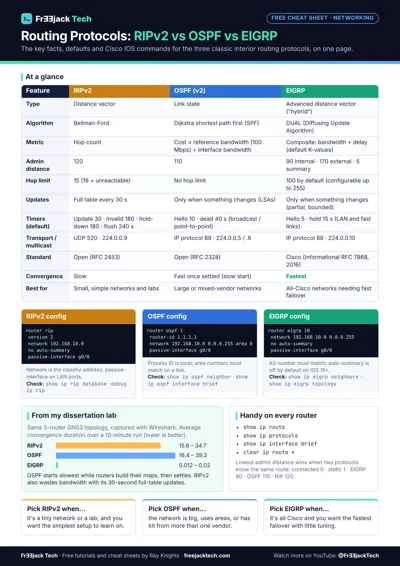
Routing Protocols Cheat Sheet
Free PDF · 1 A4 page · RIPv2, OSPF & EIGRP